
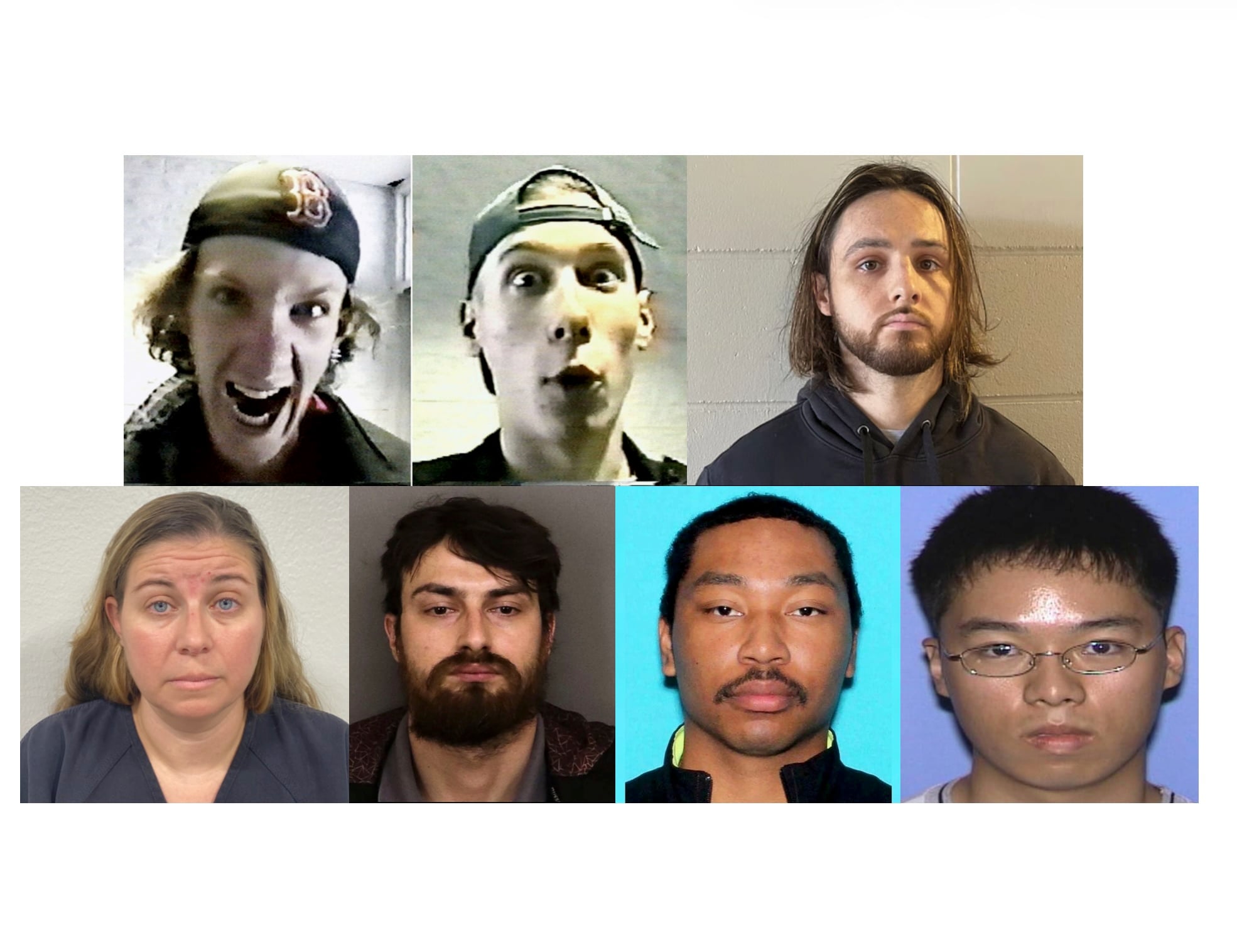
Mass public shooters often explicitly plan their attacks to maximize news coverage. As shown at the bottom of this post, many explicitly state this goal in their manifestos and diaries. These killers also study and imitate previous attackers, including by choosing gun-free zones as targets. We are now seeing a similar phenomenon with criminals inspired by Luigi Mangione murdering a businessman. Admirers have repeatedly observed that Mangione was attractive, intelligent, anti-establishment, and “morally justified.” Here are some criminals who were inspired to commit their crimes by Mangione.
- Jonathan Rinderknecht (30, California): Accused of intentionally starting the Palisades Fire (also called the Lachman Fire) in the Santa Monica Mountains on or around January 1, 2025. The fire became one of California’s most destructive wildfires, killing 12 people, destroying thousands of homes/structures, and causing billions in damage. Prosecutors state he was “fixated” on Mangione in the weeks/hours before the arson: he searched terms like “Free Luigi,” viewed Mangione as a Robin Hood-like vigilante hero against the wealthy, and ranted to Uber passengers about capitalism, the rich, and vigilantism while driving erratically. He faces federal arson charges (pleaded not guilty; trial scheduled for June 2026).
- Chamel Abdulkarim (29, California): Accused of arson at a Kimberly-Clark paper goods warehouse/distribution center in Ontario, CA, in April 2026. He allegedly filmed himself setting stacks of inventory on fire while ranting about low wages and capitalism (“All you had to do was pay us enough to live”), causing ~$500–600 million in damage. Afterward, he texted a co-worker explicitly comparing himself to Mangione (“Luigi popped that mutherf—er… a lot of people are going to understand”). He faces federal and state arson charges (pleaded not guilty).
- Daniel Moreno-Gama (also referred to as Daniel Alejandro Moreno-Gama, 20, Texas): Accused of throwing a Molotov cocktail at OpenAI CEO Sam Altman’s San Francisco home (April 2026) and later threatening to burn down OpenAI headquarters while carrying kerosene and an anti-AI manifesto. Months earlier, in online chats (including with podcast producers), he referenced “Luigi’ing some tech CEOs” as a provocative idea. He faces charges including attempted murder and arson (pleaded not guilty).
- Riley Jane English, a 24-year-old transgender woman, (also referred to in some reports as Ryan Michael English, Massachusetts): Accused of making terroristic threats/planning violence at the U.S. Capitol in January 2025, including targeting Trump administration officials. She allegedly told police she was inspired by Mangione (more cite also here). This falls under criminal threats charges.
- Briana Boston, 42, threatened her health insurance provider, Blue Cross Blue Shield, after they denied her claim. She allegedly said “Delay, deny, depose. You people are next,” and told police she used it because it was “in the news.” The words “delay,” “deny” and “depose” were written on the casings left at the scene of the shooting of UnitedHealthcare CEO Brian Thompson in a New York City.
- Shane Devon Tamura killed four before suicide) is another example of Mangione “inspiring” violence. Prosecutors in Mangione’s federal case have cited the July 2025 mass shooting at NFL headquarters in Manhattan. Tamura left anti-NFL writings (blaming football for CTE), but public reports do not show Tamura himself explicitly referencing Mangione by name.
Now here are examples of mass public shooters who were driven by their desire to get media attention.
- Seung-Hui Cho (Virginia Tech, 2007)
Cho mailed a multimedia manifesto to NBC News between the first and second phases of his attack. He repeatedly framed himself as becoming historically significant and compared himself to Columbine shooters Eric Harris and Dylan Klebold. Investigators and later analyses noted that Cho appeared obsessed with the publicity surrounding prior mass killers. After Virginia Tech, multiple later attackers explicitly referenced Cho’s death toll of 32 victims as a benchmark to exceed. - Eric Harris and Dylan Klebold (Columbine, 1999)
Their journals and “Basement Tapes” show extensive discussion about becoming infamous and being remembered forever. Harris wrote about wanting to “kick-start a revolution” and predicted movies would be made about them. They also discussed body counts and the scale of destruction they hoped to achieve. Columbine itself later became a reference point for numerous copycat attackers. - Adam Lanza (Sandy Hook, 2012)
Lanza maintained spreadsheets and research on mass killers and appears to have been highly focused on prior massacres and their notoriety. He reportedly admired Anders Breivik and other mass murderers. While he left no conventional manifesto, his writings and online activity suggest obsession with mass killings as historical events that generated attention. - Anders Behring Breivik (Norway, 2011)
Breivik’s 1,518-page manifesto explicitly discussed publicity strategy. He described the attack as “marketing” for his ideological message and carefully planned media impact, including distribution of the manifesto immediately before the killings. - Brenton Tarrant (Christchurch mosque shootings, 2019)
Tarrant’s manifesto and livestream strategy were designed explicitly for viral media dissemination. He referenced internet fame culture and meme amplification, and he intended the attack to achieve maximum online circulation. - Pekka-Eric Auvinen (Jokela school shooting, Finland, 2007)
Posted videos and a manifesto online before the attack, calling himself a “natural selector.” He sought recognition and distributed material intended to gain attention after the shooting. - Elliot Rodger (Isla Vista, 2014)
Rodger’s lengthy manifesto (“My Twisted World”) and YouTube videos repeatedly emphasized that the attack would make the world finally notice him. He explicitly connected violence with gaining recognition and historical importance. - Payton Gendron (Buffalo supermarket shooting, 2022)
His writings reflected awareness of prior mass shooters and online notoriety culture. He discussed live streaming and media impact in ways similar to Christchurch attacker Brenton Tarrant. - Audrey Hale (The Covenant School, Nashville, 2023; 6 killed) Recovered journals explicitly stated desires for infamy, including lines such as “I will die a shooter, hopefully to become infamous… and I will be the horror to inflict pain” and “It’s infamous to die young!” The writings framed the attack as a path to lasting notoriety.
- Dimitrios Pagourtzis (Santa Fe High School, Texas, 2018): According to the probable cause affidavit and police interviews, he told officers he deliberately spared certain students he liked “so he could have his story told.” Journals and writings reflected obsession with gaining notoriety through the attack.




0 Comments