
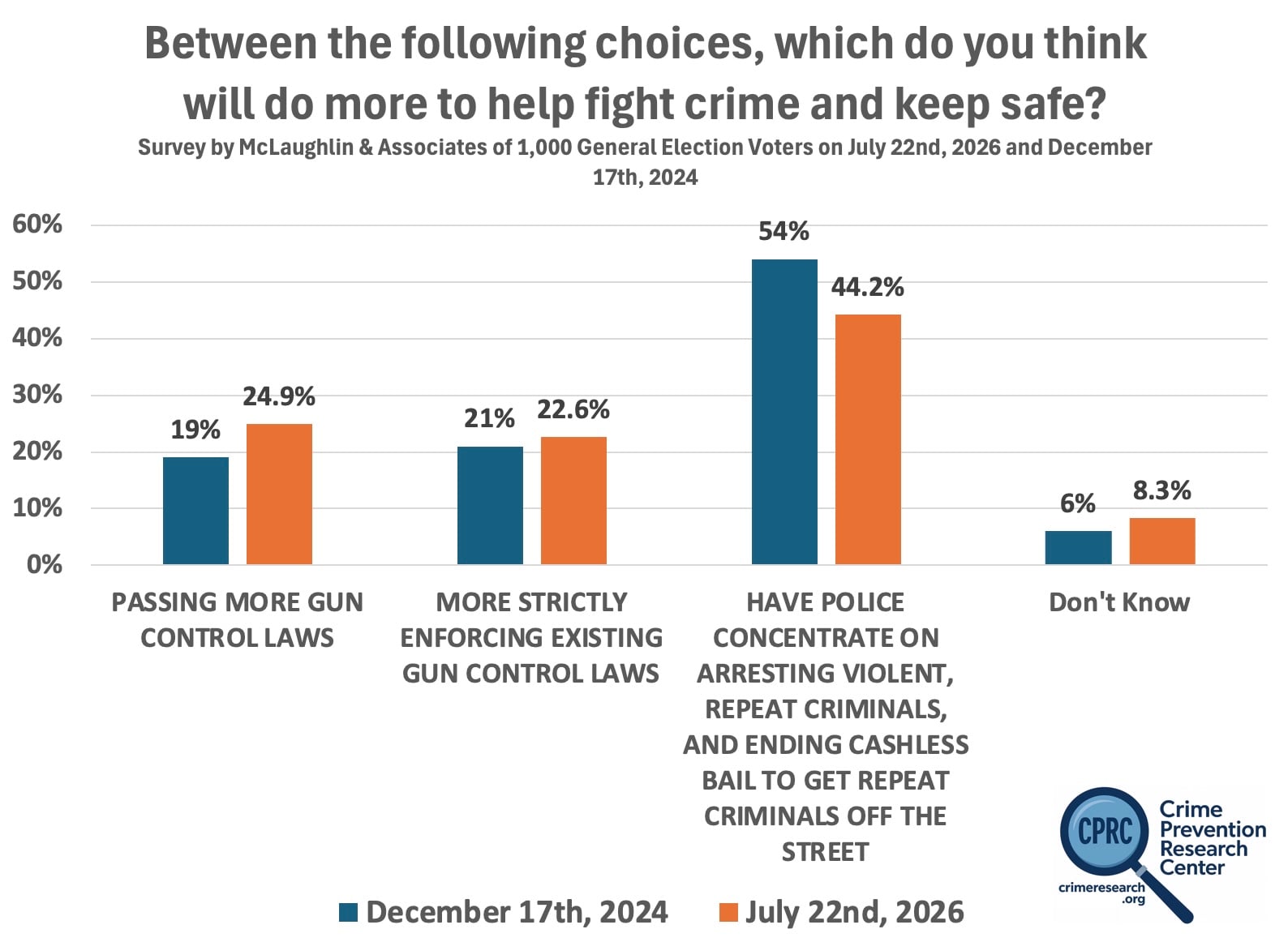
The Crime Prevention Research Center commissioned a new McLaughlin & Associates survey of 1,000 American general election voters on July 22nd, 2026 (cross tabs available here). Despite frequent claims that the public supports gun control as a way to reduce crime, only 24.9% of voters believe passing additional gun control laws would reduce crime, while an even smaller share (22.6%) believe stricter enforcement of existing gun control laws would do so. Combined, just 47.5% of voters think gun control plays the primary role in reducing crime. By comparison, 44.2% believe the better approach is to arrest criminals and keep them in jail.
Most public opinion surveys present a false choice by limiting respondents to two gun control options: passing additional gun control laws or enforcing existing ones more aggressively. That design makes it appear that the only ways to reduce crime involve gun control. Whether respondents favor new gun control laws or stricter enforcement of existing laws, both answers assume that gun control provides the primary solution.
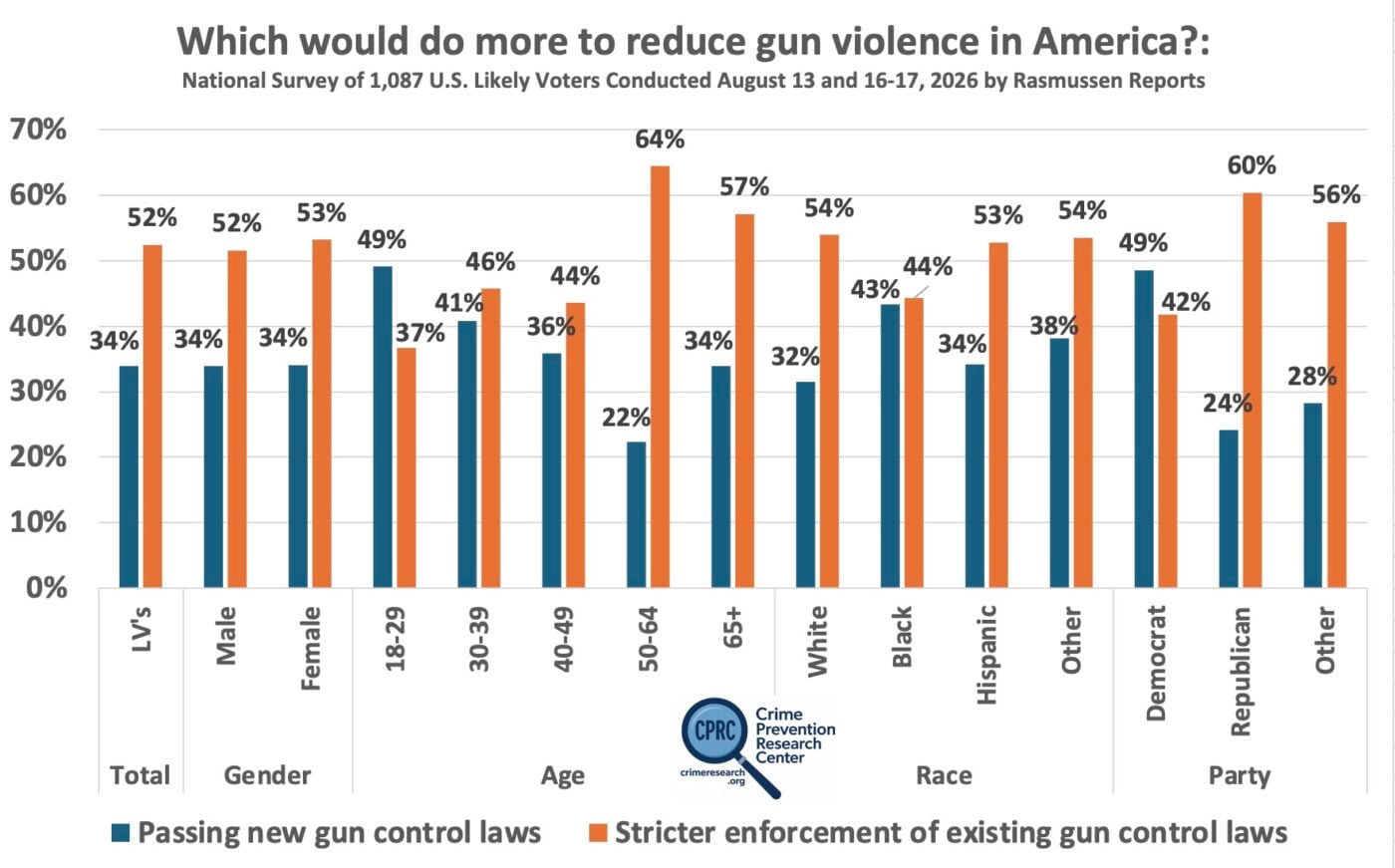
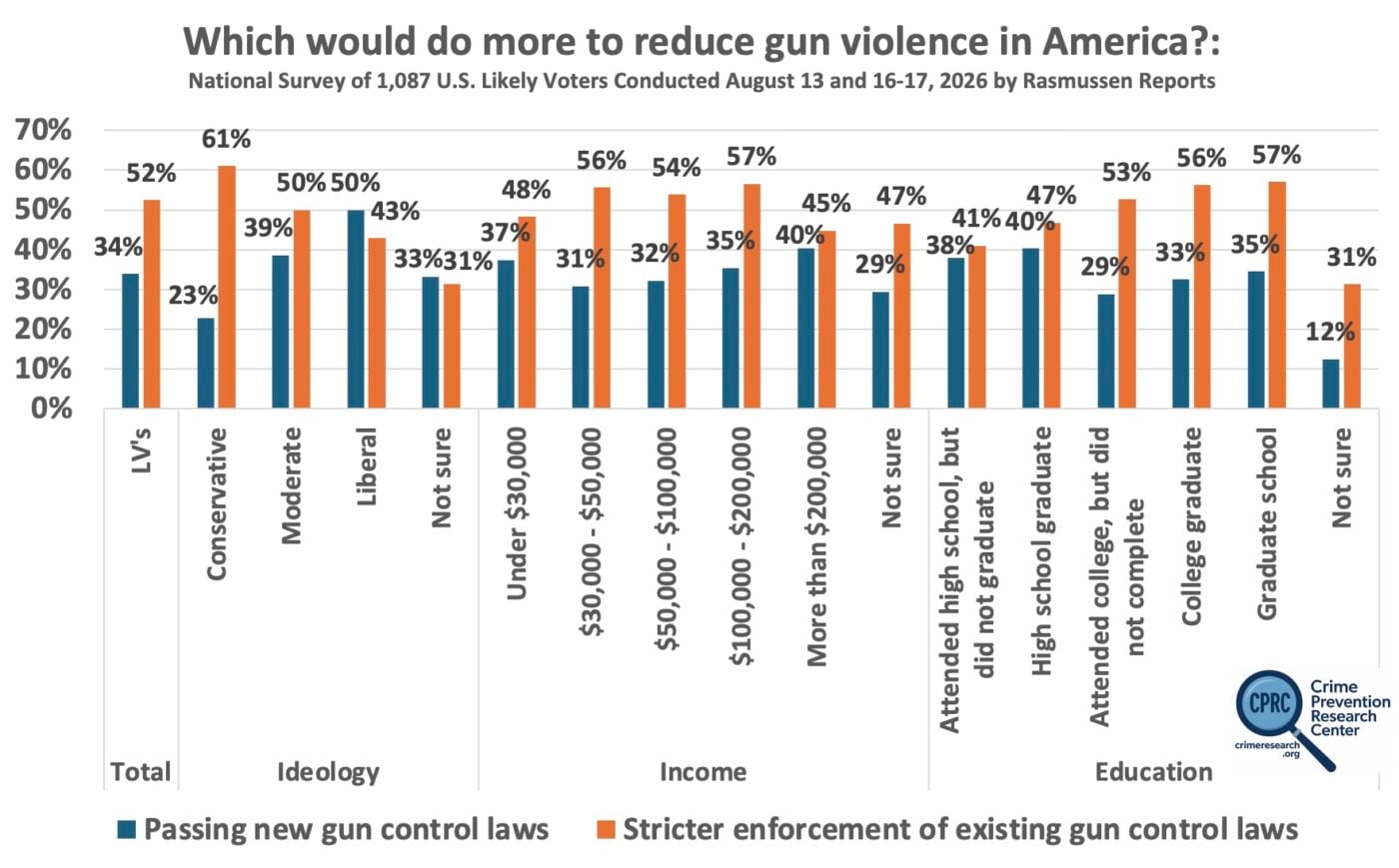
Our survey offered respondents another option—arresting criminals and keeping them in jail—and their responses changed dramatically. For example, a new Rasmussen Reports survey conducted August 13th and 16th-17th, 2026 asked the traditional question. In that survey, 52% preferred stricter enforcement of existing gun control laws and 34% favored passing additional gun control laws. Both percentages are substantially higher than in our survey, where respondents also had the option of prioritizing the arrest and incarceration of violent repeat offenders. An older Rasmussen Reports survey conducted December 17–19, 2024, asked the the question got stronger results for enforcing existing gun control laws. It found 56% preferred stricter enforcement of existing gun control laws and 31% favored passing additional gun control laws.
In our two surveys between 2024 and 2026, there was a small increase in those who wanted stricter enforcement of existing gun control while the Rasmussen survey showed a drop of four percentage points. The largest change in our survey came from a drop in support for arresting criminals and keeping them in jail — an almost ten percentage point drop, though it still has about twice the support as the other two gun control type options.
Police resources are limited. When officers spend more time enforcing gun control laws, they inevitably have less time to identify, arrest, and help convict violent repeat offenders.
Polls that ask only whether Americans favor stricter gun laws or enforcement of existing laws can also overstate the priority voters place on gun-control as a crime-reduction strategy. There’s an additional finding that may be relevant: “enforce existing gun laws” isn’t necessarily the underlying preference either. The Rasmussen 56% might initially look like overwhelming affirmative support for enforcement. But once another enforcement-oriented crime strategy is available, support for the gun-law-enforcement option drops dramatically. That suggests some respondents may be using “enforce existing laws” as the closest available way of expressing a broader preference for enforcing the law against offenders rather than creating additional restrictions.
The demographic patterns are also noteworthy. Men and women alike, as well as every age group, favor having police concentrate on arresting violent repeat criminals rather than emphasizing gun control. The same pattern holds across every racial group except Asians.
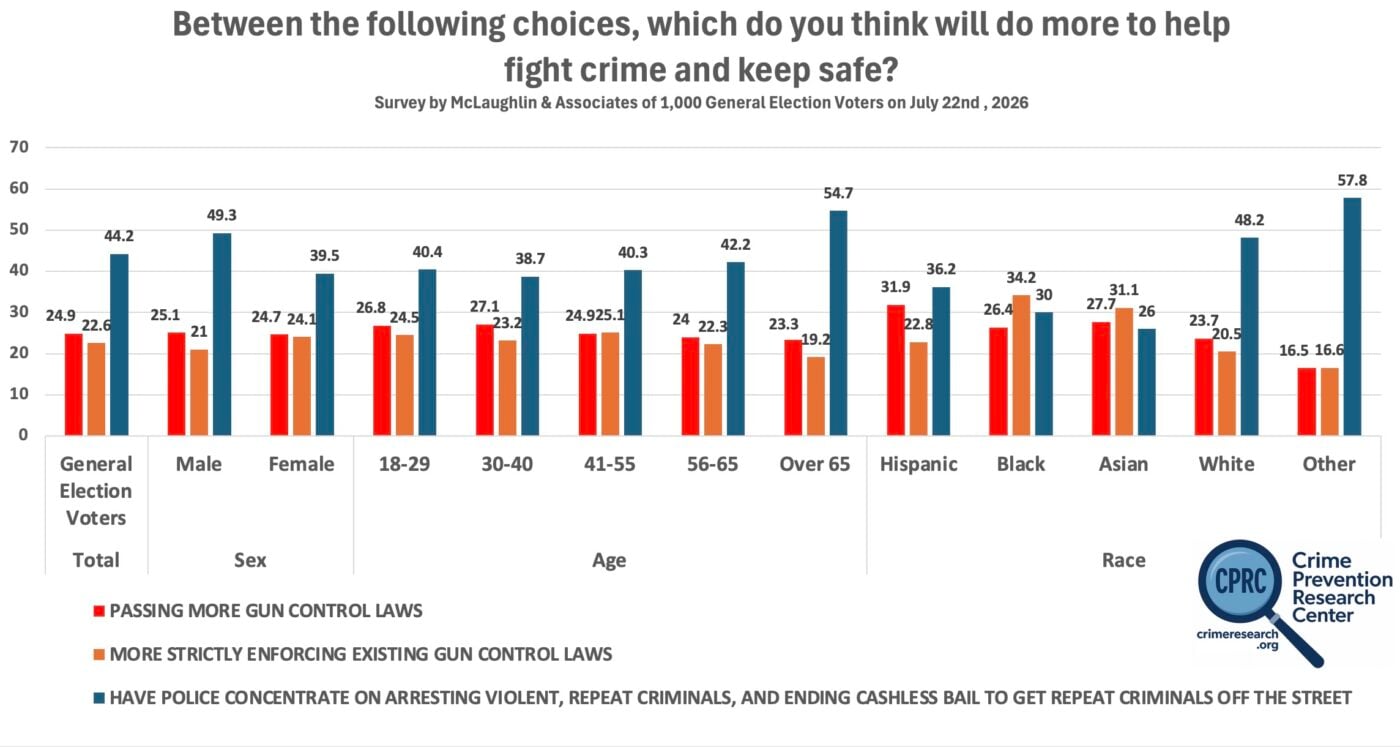
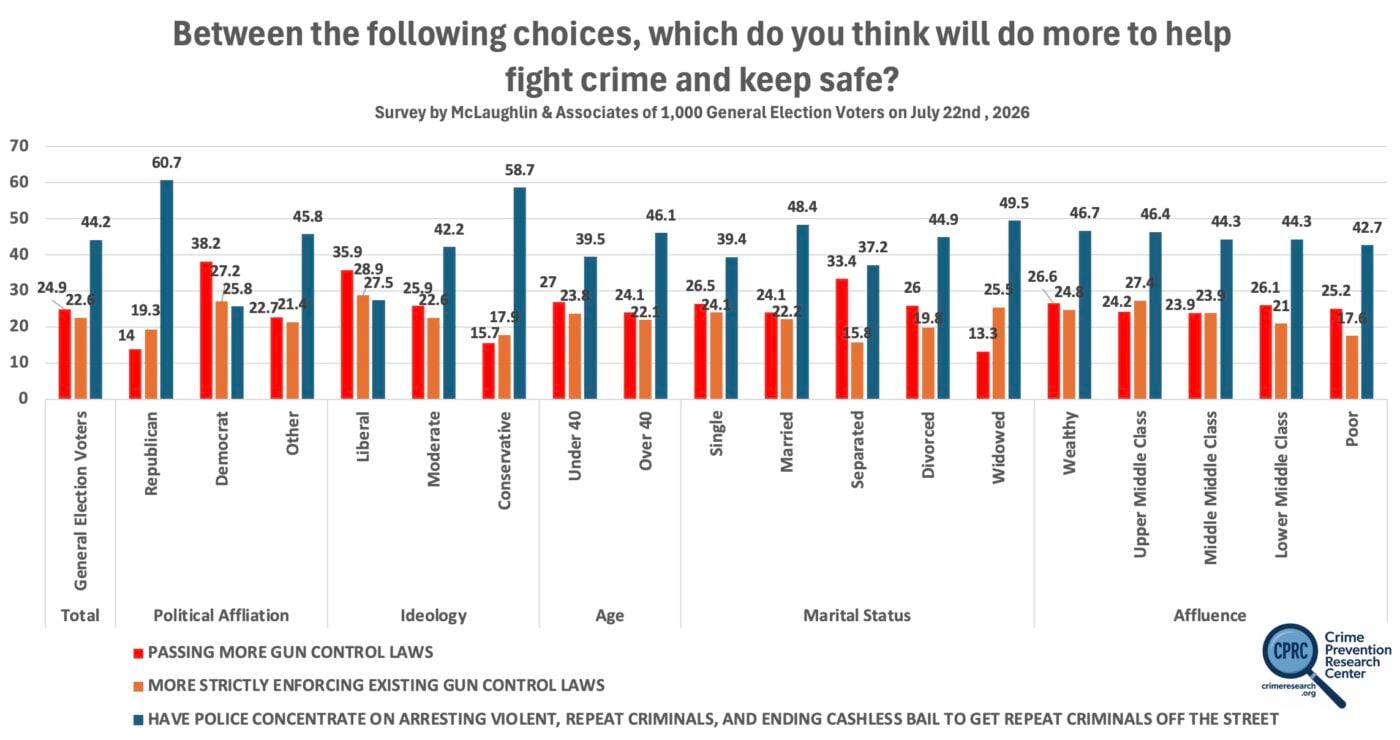
Only liberals and Democrats prioritize gun control over having police concentrate on arresting violent repeat criminals. They are the only groups that prefer either passing additional gun control laws or more strictly enforcing existing gun control laws to focusing police resources on repeat violent offenders. By contrast, every other ideological, affluence, and marital-status group favors having police concentrate on arresting violent repeat criminals.
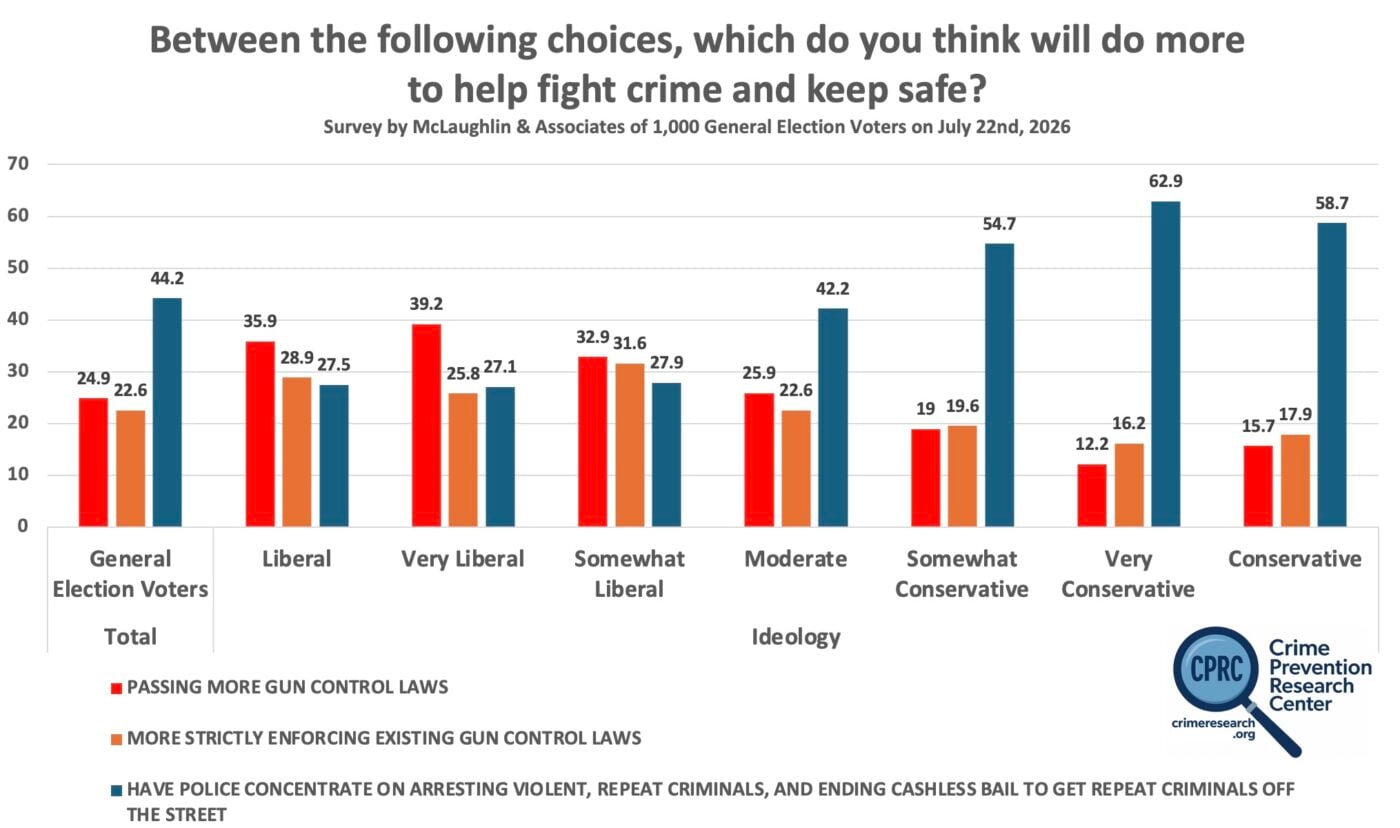
Finally, ideological views strongly predict support for additional gun control. Very liberal general election voters express the strongest support, followed in order by somewhat liberal voters, moderates, somewhat conservative voters, and very conservative voters, who express the least support.


0 Comments