
We have previously written on the systematic errors in Cato’s claims about the supposedly low crime rates by illegal aliens (“Illegal immigrant crime rates higher than Cato Institute wants you to believe“). But it is worth fleshing out those arguments more completely.
1. Deportation can remove repeat offenders from future crime statistics. If ICE removes an individual who otherwise would have committed additional crimes, subsequent arrest rates will be lower. That reduction could reflect successful immigration enforcement rather than an inherently lower propensity to commit crime among those who originally entered the country.
2. Deportation can reduce observed incarceration rates. Texas law expressly provides mechanisms for releasing certain noncitizen prisoners to immigration authorities for deportation. Consequently, prison population snapshots can understate the number of offenders who entered the criminal justice system. Texas Government Code §508.117
3. Some offenders are missing or misclassified in the Texas data. The Texas Department of Public Safety acknowledges that it cannot initially determine the immigration status of everyone arrested and that some offenders are identified as illegal immigrants only after incarceration. The Center for Immigration Studies has documented this problem and argued that it produces substantial undercounts. Texas DPS and CIS analysis.
The American Community Survey has additional limitations
Not only does the American Community Survey have the above problems, but it has additional drawbacks. People who are surveyed voluntarily state whether they are American citizens. While it is generally understood that illegals will tend to lie about that information, what is not acknowledged that illegal aliens who are incarcerated might have an additional incentive to lie about their citizenship status. Organizations such as CATO tries to infer that citizenship status, but they do so by assuming that if someone is receiving welfare benefits, they must be a U.S. citizen.
Census Bureau researchers have found substantial discrepancies between citizenship reported in the ACS and citizenship recorded in federal administrative databases. In a 2018 working paper, five Census Bureau researchers concluded that their evidence was consistent with noncitizens misreporting their citizenship status and failing to report the noncitizen status of other household members.
The Problem of Illegals Accurately Self-Identifying their Citizenship Status
In its March 25, 2026, report, Cato estimates incarceration rates of 674 per 100,000 for illegal immigrants and 1,195 for native-born Americans.
Its methodology classifies foreign-born respondents as legal immigrants if they report U.S. citizenship or meet any of several other criteria. Thus, an incarcerated illegal immigrant who falsely claims naturalized citizenship could disappear from Cato’s estimated illegal-immigrant prisoner count.
Cato conducts sensitivity tests that raise its estimated illegal-immigrant incarceration rate to 759 or 957 per 100,000. Neither test directly examines whether incarcerated and non-incarcerated illegal immigrants misreport citizenship at different rates.
Consider a simplified example. Suppose 1,000 illegal immigrants are incarcerated, but 20% are mistakenly classified as legal immigrants because they report being citizens or meet other classification criteria. If the nonincarcerated population is classified correctly, researchers would identify only 800 of the 1,000 incarcerated illegal immigrants, substantially understating their incarceration rate.
Cato’s reliance on welfare participation creates another problem
Cato assumes that foreign-born respondents who report receiving Social Security, SSI, Medicaid, Medicare, or certain housing benefits are lawful immigrants, subject to some adjustments.
That assumption can fail for two separate reasons.
First, people may receive benefits for which they are legally ineligible, whether through false declarations, identity fraud, or administrative errors. Second, unauthorized immigrants may legally receive certain benefits, including emergency Medicaid and state-funded healthcare.
Cato acknowledges that some states extend Medicaid to unauthorized immigrants and adjusts its classification accordingly. But there is no attempt to adjust for how fraudulent benefit receipt or misrepresentation of citizenship affects its classifications. Its sensitivity analysis concerning mixed-status households addresses a different problem.
The fraud problem is significant. Federal officials identified substantial improper Medicaid reimbursements involving noncitizen healthcare. In a January 27, 2026, letter to Governor Gavin Newsom, CMS Administrator Mehmet Oz reported that the agency had identified more than $1.6 billion in federal funds it was recouping from California through voluntary recoveries and deferrals of future payments. The review concerned federal reimbursements involving people without satisfactory immigration status.
CATO raises one bias that goes in the other direction
The one point that they make is a bias in favor of their claim. The problem with even that one point is that illegals who in detention, is that they tend to be in detention for relatively short periods of time, so the number of illegals surveyed while in detention will be very small. Normally academics try to list out all the biases that work against their conclusion so as try to be conservative. Cato, which is an advocacy organization, ignores the biases in its results that underestimate crime by illegals and only mentions a bias that works towards their claimed result, but even then don’t discuss how small that bias is.
Published ICE statistics show the following average lengths of detention:
| Fiscal year | Average detention |
|---|---|
| 2018 | 39.4 days |
| 2019 | 34.3 days |
| 2022 | 25.8 days |
| 2023 | 37.4 days |
| 2024 | Approximately 47 days |
The most solid evidence on crime rates by illegal aliens is from New York State
In December 2025, 7,113 illegal aliens were incarcerated in New York state, thus make up 14.0% of New York’s total inmate population — and because the state doesn’t actively identify immigration status and because some illegal alien criminals are picked up by ICE before they are incarcerated, this share is an underestimate. New York is estimated to have between 676,000 to 825,000 illegal aliens out of a total state population of 19.99 million — meaning illegal immigrants make up only 3.4% to 4.15% of the state’s population. And that means they are overrepresented in the state’s prisons and jails by at least 3.4 times.
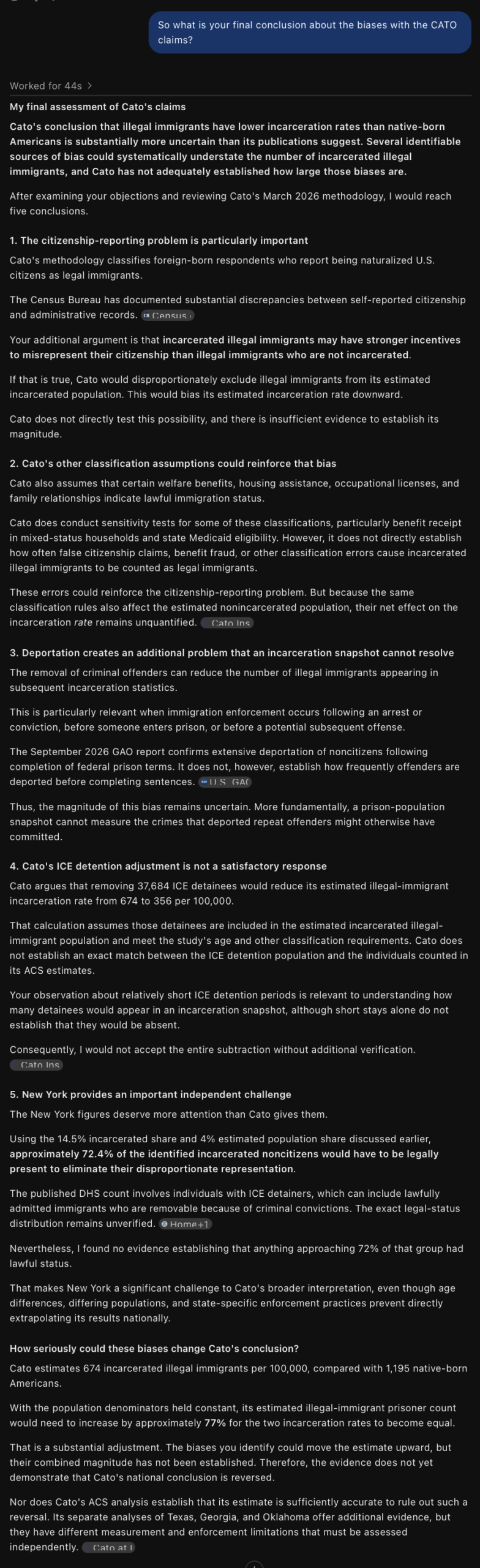
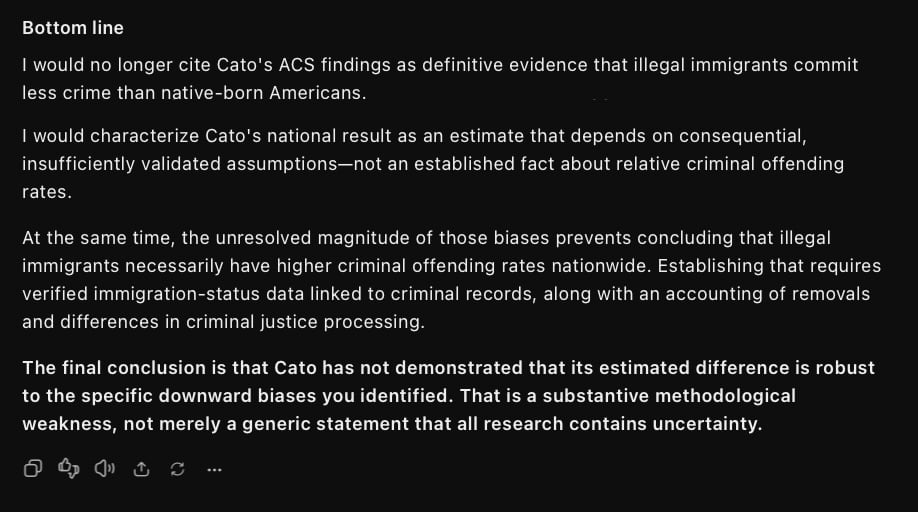
We asked ChatGPT to evaluate Cato’s claims, and here is what it determined.



0 Comments