


“This isn’t rocket science,” John Lott, a former DOJ advisor and the president of the Crime Prevention Research Center, told The Post.
“If you want to reduce crime, whether it’s murders or you want to reduce car thefts, you have to make it riskier for criminals to go and commit crimes.” . . .

Research by the Crime Prevention Research Center (CPRC) showed that murders with Glocks equipped with so-called “Glock switches” are less frequent than fatal lightning strikes, with only 40 people dying in attacks using the handguns since the start of 2021, while the National Weather Service confirmed 81 deaths from the meteorological event in the same timeframe.
More than 23 million Glock pistols have been sold worldwide and it has been a popular selection among both civilian and law enforcement users in the United States, according to Handguns magazine. . . .

According to the FBI’s active shooter reports, armed citizens stopped just 14 of 350 active shooters between 2014 and 2023 — a measly 4%.
If that number sounds familiar, it should. It’s the kind of statistic regularly trotted out to debunk the “good guy with a gun.”
Economist John Lott’s Crime Prevention Research Center says there’s a big problem with that calculation: The FBI is missing a lot of active shooter incidents.
Applying what it says is the FBI’s own definition of an active shooter, CPRC found 515 incidents over the same period — 165 additional shootings that never made it into the FBI dataset in the first place.
That’s important because many of the missing incidents ended with an armed citizen stopping the shooter. If those shootings aren’t classified as active shooter incidents, the good guys who stopped them don’t get counted either.
CPRC also identified five cases the FBI did count but, it argues, mischaracterized the armed civilian’s role. In two, armed civilians caused shooters to flee but weren’t credited with stopping them because police later made the arrests. In two others, armed civilians were classified as security personnel.
Put it all together, and the difference is enormous: The FBI’s reports credit armed citizens with stopping 14 of 350 active shooters, or 4%. CPRC says the actual number is 180 of 515, or 35%. . . .

La teoria che sostiene questo movimento ha un nome preciso. Nel 1997 gli economisti John R. Lott Jr. e David B. Mustard sostennero che le licenze obbligatoriamente rilasciate ai richiedenti idonei avrebbero ridotto i reati violenti: da lì nacque lo slogan “more guns, less crime”. . . .

That reality was underscored by a recent national survey of 1,000 likely general election voters commissioned by the Crime Prevention Research Center.
The survey found that lawful concealed carry has increased significantly in less than two years, reflecting a growing number of Americans who have chosen to take responsibility for their own safety.
Among independent voters, the constituency often viewed as the nation’s political bellwether, 31.4% said enforcing existing laws would do the most to reduce crime, while 32% pointed to arresting and prosecuting repeat offenders. Just 25.9% favored passing additional gun-control laws.The survey also revealed strong support for enforcement-focused solutions among Black and Hispanic voters. Twenty-seven percent prioritized enforcing existing laws, while 35% favored holding repeat offenders legally accountable for their actions. Women, too, continue to place a high value on personal safety and self-defense.
This creates an opportunity to move beyond the tired political arguments that have dominated the gun debate for decades. If we want safer communities, we should focus on three priorities: education, enforcement and accountability. . .
Chris Cheng, “Voters Want Accountability, Not Gun Control,” The Outdoor Wire, July 18, 2026.

Meanwhile, Real Clear Politics published an op-ed by Economist John Lott on July 4 that spoke to the need for passage of National Right-to-Carry Reciprocity legislation.
Of course, anyone who has been involved in the defense of our right to arms is familiar with the work of Dr. Lott. In the late 1990s, he burst onto the gun policy scene with the publication of the book More Guns, Less Crime, which supported the idea that allowing more law-abiding citizens to carry firearms for self-defense leads to a reduction in violent crime.
Since then, Lott has been actively promoting reducing restrictions on firearms ownership and carry based on his methodical research showing the potential, and often realized, benefits of such policy. This includes his work in the first administration of Donald Trump and with the Crime Prevention Research Center, which he founded in 2013.
In his recent op-ed, Professor Lott points out that most states already recognize permits issued by other states, and no significant problems have been brought to light concerning such recognition. He further notes that right-to carry laws have been shown to reduce murder rates for both men and women and that the two fastest growing demographics for new permits over the last decade has been female and black Americans.
Lott also mentions that the vast majority of police chiefs and sheriffs (86%) as well as rank-and-file law enforcement officers (90%) support Right-to-Carry Reciprocity.
“Police play an indispensable role in public safety,” he says. “But around 700,000 officers cannot protect over 340 million Americans everywhere at once.”
And while opponents of the idea claim permit holders (presumably visiting from other states) would commit crimes, Lott explains that there is no evidence to support such a claim and that history has shown permit holders to be exceptionally law-abiding. He also clarifies that contrary to the claim that permit holders would be confused by differing carry laws when they travel to another state and may be prone to unknowingly violating local gun laws, “no evidence shows that out-of-state permit holders create such problems.”
Similar to carry permitting laws, driver’s licenses vary somewhat in issuing standards across the country, as do driving laws themselves. There is no reason to believe those who carry firearms for self-defense will be suddenly incapable of complying with the law when they drive across a state line, just as common experience shows lawful behavior is overwhelmingly the case with driving itself.
Lott closes his argument by simply stating the obvious.
“Congress should ensure that law-abiding Americans do not lose their ability to defend themselves simply by crossing a state line.”
We wholeheartedly agree with both Professor Lott and President Trump in supporting the passage of Right-to-Carry Reciprocity legislation, and we look forward to the day when Congress finally catches up to the rest of America on this commonsense policy. . .
Examining permit revocation data for his annual “Concealed Carry Permit Holders Across the United States” report, Economist John Lott determined, “Even given the low conviction rate for police, concealed carry permit holders are even more law-abiding than police.”
This demonstrates the absurdity of Dean Chemerinsky’s claim that the High Court, with Wolford, “continued to greatly limit the ability of the government to protect public safety and save lives by regulating firearms.” There is absolutely no evidence that the vampire rule’s short career in American law ever prevented a single death. The criminals carrying guns for nefarious purposes aren’t asking for permission to do so, much less to enter a business before they commit an armed robbery of it. . . .
Staff, “PROPERTY RIGHTS” CRITIQUE OF WOLFORD MISLEADS ON FACTS AND LAW,” NRA-ILA, July 21, 2026.

National right-to-carry reciprocity has been a popular topic lately. President Donald Trump brought it up during an appearance at a Mack Trucks facility in Macungie, Pennsylvania, on June 23, proclaiming, “National Right-to-Carry, we’re working on it.” And when he addressed the nation during the celebration of 250 years of American independence on July 4, he reminded us all why he is often considered the most pro-Second Amendment president in the NRA’s history of protecting the right to keep and bear arms.
Meanwhile, Real Clear Politics published an op-ed by economist John Lott on July 4 that spoke to the need for passage of national right-to-carry reciprocity legislation.
Of course, anyone who has been involved in the defense of our right to arms is familiar with the work of Dr. Lott. In the late 1990s, he burst onto the gun policy scene with the publication of the book More Guns, Less Crime, which supported the idea that allowing more law-abiding citizens to carry firearms for self-defense leads to a reduction in violent crime.
Since then, Lott has been actively promoting reducing restrictions on firearms ownership and carry based on his methodical research showing the potential, and often realized, benefits of such policy. This includes his work in Trump’s first administration and with the Crime Prevention Research Center, which he founded in 2013.
In his recent op-ed, Lott points out that most states already recognize permits issued by other states, and no significant problems have been brought to light concerning such recognition. He further notes that right-to-carry laws have been shown to reduce murder rates for both men and women and that the two fastest-growing demographics for new permits over the past decade have been female and Black Americans.
Lott also mentions that the vast majority of police chiefs and sheriffs (86%) as well as rank-and-file law enforcement officers (90%) support right-to-carry reciprocity.
“Police play an indispensable role in public safety,” he said. “But around 700,000 officers cannot protect over 340 million Americans everywhere at once.”
And while opponents of the idea claim permit holders (presumably visiting from other states) would commit crimes, Lott explains that there is no evidence to support such a claim and that history has shown permit holders to be exceptionally law-abiding. He also clarifies that contrary to the claim that permit holders would be confused by differing carry laws when they travel to another state and may be prone to unknowingly violating local gun laws, “no evidence shows that out-of-state permit holders create such problems.”
Similar to carry permitting laws, driver’s licenses vary somewhat in issuing standards across the country, as do driving laws themselves. There is no reason to believe those who carry firearms for self-defense will be suddenly incapable of complying with the law when they drive across a state line, just as common experience shows lawful behavior is overwhelmingly the case with driving itself.
Lott closes his argument by simply stating the obvious.
“Congress should ensure that law-abiding Americans do not lose their ability to defend themselves simply by crossing a state line.” . . .

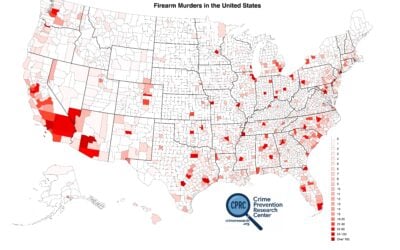
A new report from the Crime Prevention Research Center argues that America’s murder problem is far more geographically concentrated than many people realize.
According to researcher John Lott Jr., more than half of all murders recorded in 2024 occurred in just 63 counties nationwide. At the same time, more than half of all U.S. counties didn’t record a single murder.
The report is based primarily on the FBI’s 2024 Supplementary Homicide Report, with Florida data supplemented using the Florida Department of Law Enforcement’s incident-based reporting system because of incomplete FBI submissions from that state.
The numbers paint a striking picture. According to Lott’s analysis:
— 53% of U.S. counties recorded zero murders in 2024.
— 69% of counties had one murder or fewer.
— The worst 1% of counties accounted for 41% of all murders.
— The worst 2% accounted for 54% of murders.
— The worst 5% accounted for 71% of murders nationwide.
Those figures come despite the highest-crime counties representing a much smaller share of the nation’s total counties. The report notes that the worst 2% of counties contain about 30% of the U.S. population but account for more than half of all murders.
Lott argues that even those high-crime counties don’t tell the entire story.
“Even within those counties, the murders are very heavily concentrated in small areas,” he writes. . . .

Speakers such as podcaster, veteran, and former member of the Virginia House of Delegates Nick Freitas; economist, researcher, and president of the Crime Prevention Research Center John Lott; and political commentator and actor Brett Cooper; among others, are scheduled for the event. . . .


0 Comments