


According to John Lott, Jr.—author of More Guns Less Crime: Understanding Crime and Gun Control Laws—it’s good.
Initially published in 1998, and now in its third edition, Lott’s book “directly challenges common perceptions about the relationship of guns, crime, and violence.”
According to Lott, when a civilian with a gun confronts a bad guy with a gun, “they’re overwhelmingly successful.”
Unfortunately, most of these instances are not reported, and when they are, they don’t make it past local news. . . .
A study, released by the Crime Prevention Research Center (CPRC) earlier this year, shows that concealed carriers do a better job of stopping active shooters than the police. In an op-ed at The Federalist, Lott said, “In non-gun-free zones, where civilians are legally able to carry guns, concealed carry permit holders stopped 51.5 percent of active shootings, compared to 44.6 percent stopped by police, CPRC found in a deep dive into active shooter scenarios between 2014 and 2023.”
There are two logical reasons why civilians succeed in stopping bad guys: First, they are already on the scene and, second, the perpetrator does not recognize them as a threat.
In his book, Lott points out that “Criminals are motivated by self-preservation, and handguns can therefore be a deterrent. The potential defensive nature of guns is further evidenced by the different rates of so-called ‘hot burglaries,’ where a resident is at home when a criminal strikes. In Canada and Britain, both with tough gun-control laws, almost half of all burglaries are ‘hot burglaries.’ In contrast, the United States, with fewer restrictions, has a ‘hot burglary’ rate of only 13 percent.”
For those who worry about those legally carrying a gun, Lott said, “Permit holders committed murder at 1/182nd the rate of the general public.” . . .
Dennis Warden, “Guns, Guns, and More Guns,” Gasconade County Republican (Owensville, MO), November 5, 2025.

One of the most emblematic texts is by John R. Lott Jr., which argues in favor of gun ownership as a means of protecting life and individual liberty. Through empirical data and an analytical approach, Lott maintains that restrictions on firearms are not only ineffective but can also increase crime. His work invites reflection on the balance between public safety and individual rights. . .

A new analysis by the Crime Prevention Research Center (CPRC) found that the FBI has understated the number of times armed civilians have stopped active shooter incidents in the United States.
According to the FBI, civilians stopped just 14 out of 374 active shooter cases between 2014 and 2024, which is a rate of 3.7%.
But the CPRC, a nonprofit data watchdog on crime issues, said it uncovered 561 incidents during the same period, with armed citizens stopping 202 of them, or 36%. CPRC said the percentage jumped to 52.5% when excluding shootings that occurred in “gun-free zone” . . .

No one knows exactly what percent of the population “identifies as” trans. One may identify as trans Monday, as a furry Tuesday and recognize biology Wednesday. However, most guesstimates suggest a range from 0.3% to 0.5%.Most mass public shooters are male—96.1%–to 3.9% of females. Dr. John R. Lott of the Crime Prevention Research Center notes that from 2018-2024, 5% of America’s mass shooter attacks were committed by trans. Lott also found, assuming 0.73% of the population is trans, they commit mass attacks at 6.82x their share of the population. . . . .
Mike McDaniel, “Are trans–and trans shooters–on the way out?” American Thinker, November 1, 2025.

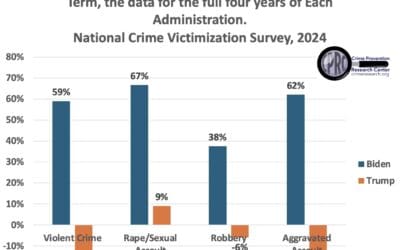
Economist John Lott, who frequently reports on crime, writes, “A new Bureau of Justice Statistics report, which includes data through 2024, shows that Trump was right during the debate when he said, ‘Crime here is up and through the roof.’ The National Crime Victimization Survey shows violent crime surged 59%, with rape and sexual assault up 67%, robbery up 38%, and aggravated assault up 62%. That’s the largest four-year increase in the survey’s 52-year history.”
Lott points to another phenomenon that our Mark Alexander highlighted recently — the FBI’s crime data is becoming increasingly unreliable.
There are two key reasons for this. First is the aforementioned problem of Democrat stat manipulation. For example, Lott notes, “Downgrading aggravated assaults to simple assaults removes them from the FBI’s violent crime statistics.” Reducing charges is a big problem: “In Manhattan, for example, the district attorney’s office downgraded felonies 60% of the time — with 89% downgraded to misdemeanors and 11% to less serious felonies.”
The most famous exception to Manhattan DA Alvin Bragg’s scheme was, of course, Donald Trump. Bragg craftily upgraded a couple of bookkeeping violations to 34 felonies so he could affix the label “convicted felon” to the GOP presidential candidate. Seventy-seven million Americans saw through the charade.
The second reason for faulty FBI stats is harder to pin down — the reluctance of victims to even bother reporting a crime. “When people believe police won’t catch or prosecutors won’t punish criminals,” Lott explains, “they’re simply less likely to report crimes. Between 2010 and 2019, victims reported 63.3% of violent crimes to police. In the last three years, that number plummeted to 48.8%. Arrests fell as well — from 26.5% before COVID-19 to just 16.6% afterward.” . . .
Nate Jackson, “Lies, Damned Lies, and Crime Statistics,” The Patriot Post, October 21, 2025.

The Crime Prevention Research Center’s most recent update on concealed carry in the United States came out last December, but put the number at that time to 21.46 million. That represented a drop of about 1.8 percent from the previous year, and CPRC attributes that to the expansion of “Constitutional Carry” laws. . . .

IT’S NOT JUST COLORADO, CRIME REALLY IS UP And John Lott writes about the real numbers here.
Mandy Connell, “Colorado Let Criminals Out Of Jail, Crime Went Up,” KOA 850 AM Denver, October 21, 2025.

According to new analysis from the Crime Prevention Research Center (CPRC), violent crime surged 59% during Biden’s four years in office—the largest increase on record.
Those numbers come from the Bureau of Justice Statistics’ National Crime Victimization Survey (NCVS), a data set that captures both reported and unreported crimes. The trend stands in sharp contrast to the 15% drop in violent crime seen during President Donald Trump’s (R) first term, according to the same data sources.
When Biden took office in January 2021, the country was already grappling with a pandemic spike in violence. His administration promised that stricter gun regulations, from red-flag laws to expanded background checks to limits on private sales, would help reverse the trend. But by the end of 2024, the opposite had occurred.
The CPRC’s review of the NCVS found that rapes and sexual assaults rose 67%, robberies climbed 38% and aggravated assaults jumped 62% under Biden’s tenure. Even comparing 2024 to the pre-pandemic year of 2019, violent crime remained up 22%, the second-largest five-year increase since federal records began tracking victimization rates.
At the same time, fewer Americans were reporting crimes to the police. Between 2010 and 2019, about 63% of violent crimes were reported; however, that figure fell to less than half, 48.8%, during Biden’s last three years in office. Arrests plummeted just as steeply. Only 16.6% of violent crimes resulted in arrests during that period, compared with 26.5% during the previous decade. . . .

The Crime Prevention Research Center’s most recent update on concealed carry in the United States came out last December, but put the number at that time to 21.46 million. That represented a drop of about 1.8 percent from the previous year, and CPRC attributes that to the expansion of “Constitutional Carry” laws. . . .

For those under age 18, vehicle deaths are consistently greater than those from firearms. When you use the FBI murder data, the vehicle deaths exceed the firearm deaths for 2019, 2020, 2022, and 2023 — and likely 2021, though the FBI data isn’t available for that year.
About 72% of the firearm murders for those under 18 involve 15-, 16-, and 17-year-olds. So that would be 40% of all the firearm deaths. About 57% of those involve 16- and 17-year-olds. That is 32% of all firearm deaths. These deaths are largely gang-related, and even banning guns is unlikely to stop drug gangs from getting a hold of guns to protect their extremely valuable drugs.
Suffocation deaths for those under 18 are greater than total firearm deaths using the FBI data in both 2019 and 2020 (2,253 and 2,110, respectively). It is almost the same as the number in 2022 and 2023 (2,154 and 2,042, respectively).
Suicides should also be excluded because the common claim is that if guns are eliminated, people either won’t try to commit suicide or cannot do it successfully. Yet in places where guns are banned, total suicide rates remain unchanged — people change how they commit suicide.
From 2019 to 2023, excluding firearm suicides would reduce numbers from the CDC by 27% to 39%. With the FBI murder data, firearm suicides make up 31% to 46% of the total. For example, in 2020, for those under age 20, removing suicides would reduce the number of firearm deaths using the numbers from the CDC from 4,253 to 2,960 and, using the FBI murder rate data, from 3,405 to 2,112.
There are many other very effective ways to commit suicide, such as hanging, walking in front of a train, jumping from a height, using explosives, or cyanide (source here). More on suicides is available here. . . .


0 Comments