
UPDATE: Strangely, the media coverage in places such as Politico, Washington Post, and New York Times discuss the role of Trump appointees but not the fact that this extremely strong decision was written by a Biden appointee. Indeed, three Biden appointees voted to strike down the ban (Freeman, Montgomery-Reeves, and Chung, though Chung’s position was divided).
The articles emphasize that all the other federal appeals courts besides the 3rd Circuit that have considered this issue have upheld the bans. “Every other federal circuit court to consider the issue has come out the other way,” New Jersey Attorney General Jennifer Davenport said. Similarly, Adam Winkler dishonestly claims that the 3rd Circuit decision was “surprising,” but anyone who listened to the oral arguments knows this decision was completely expected. It was also the
Adam Winkler, a law professor at the University of California, Los Angeles, said that Friday’s ruling was surprising because federal courts of appeals have upheld assault weapons bans in the past.
What is most interesting is the number of Democrat Circuit court judges who didn’t toe the standard political line that Democrats were expected to take.
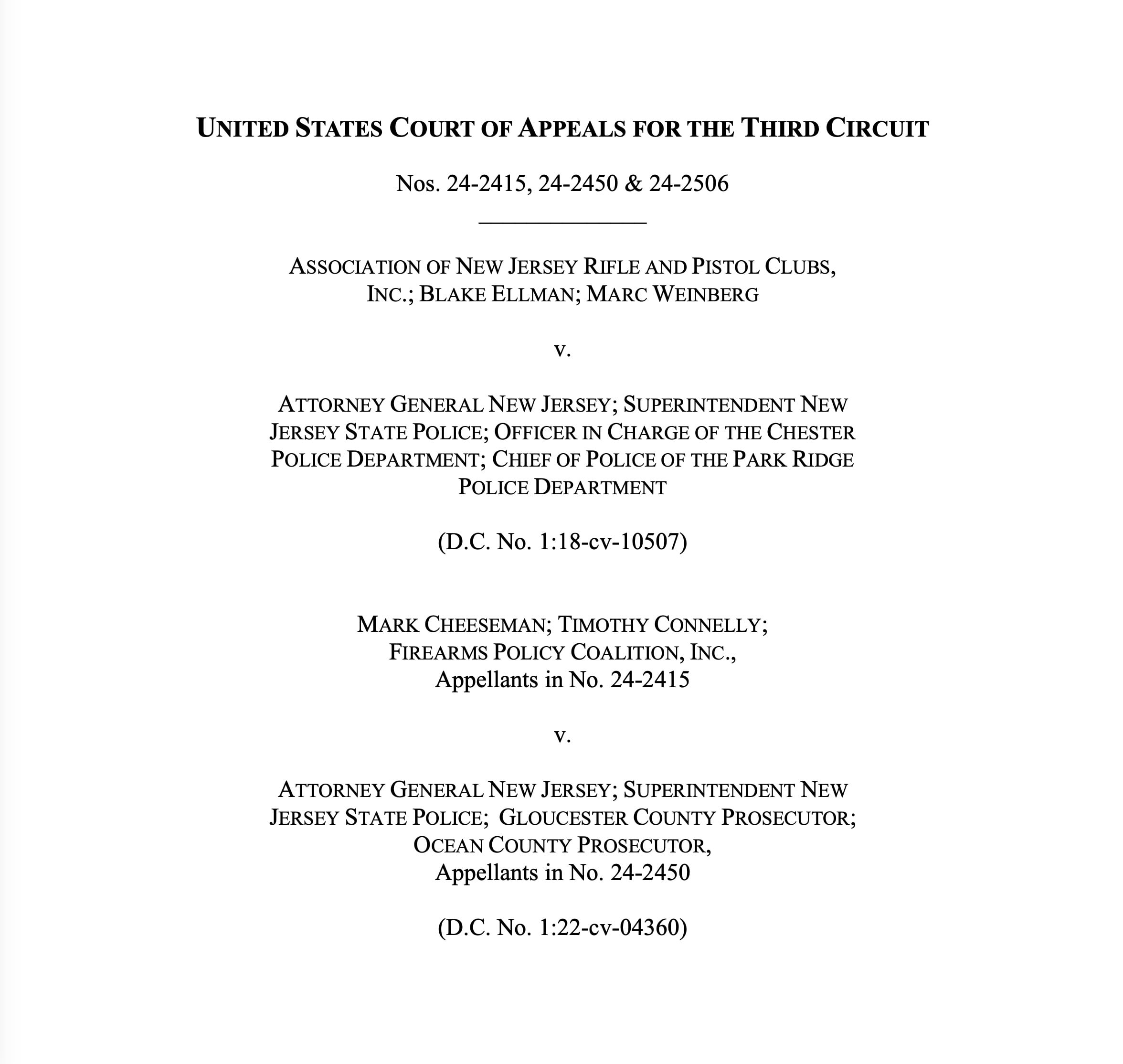
Original: As expected, the U.S. Court of Appeals for the 3rd Circuit, in an en banc decision, has struck down New Jersey’s prohibitions on semi-automatic rifles and large-capacity magazines. It is a major decision because he creates a circuit court split for the first time. The Supreme Court is already scheduled to hear similar cases from Chicago and Connecticut this December. The decision was 15 judges who wanted to strike down the bans, one Obama appointee who supported striking down the AR-15 ban but supported the large capacity magazine ban, and three who dissented. A copy of the decision is provided here.
Surprisingly, the U.S. Court of Appeals for the Third Circuit, in an en banc decision, was written by Judge Arianna J. Freeman, a Biden appointee, She found New Jersey’s prohibitions on semi-automatic rifles and large-capacity magazines fail the Supreme Court’s history-and-tradition test from Bruen. The court noted about 24 million such rifles are in common use for lawful purposes nationwide, with no historical basis for the magazine limits. While the ruling deepens a circuit split and sets up likely Supreme Court review, the bans stay in place pending appeals.
Her decision was a strong one, though some of the more conservative judges put in opinions concurring with finding the ban unconstitutional, but they disagreed on issues such as whether it was necessary for the case to be remanded to the district court for further consideration.
Applying the framework announced in New York State Rifle & Pistol Association v. Bruen, 597 U.S. 1 (2022), we agree with the District Court that New Jersey’s ban on Colt AR-15s violates the Second Amendment. However, because the record supports the same result for all semi-automatic rifles—not only Colt AR-15s—we will MODIFY the District Court’s order so that it deems the Assault Firearm Provisions unconstitutional with respect to the full class of semi-automatic rifles. We will AFFIRM that part of the order as modified.
The LCM Provisions also violate the Second Amendment, so we will REVERSE the District Court’s order with respect to those. Because the LCM Provisions violate the Second Amendment, we need not address the Takings Clause challenge.
We will REMAND these matters to the District Court for further proceedings, including for resolution of the Second Amendment challenge to the other models and types of firearms covered by the Assault Firearm Provisions.
Freeman followed the two part test in Bruen. In a particularly important discussion, Freeman notes that when faced with choosing between the regulations in effect in 1791 when the Second Amendment was adopted or 1868 when the 14th Amendment was adopted, we should use the founding period. It has been clear to many that the Supreme Court was implying that the regulations in effect in 1791 were the relevant standard.
When conducting the historical inquiry, we saw that the principles underpinning Founding-era firearm regulations pointed in one direction while the principles underpinning mid-to-late-nineteenth century laws pointed in the opposite direction. Id. at 441. Faced with an “irreconcilable conflict” between the laws of those two timeframes, we concluded that we must look to Founding-era laws for analogies to modern-day regulations. We reached that conclusion based on the Supreme Court’s guidance that the Second Amendment’s “meaning is fixed according to the understandings of those who ratified it.”
She also makes it clear that the Second Amendment protections aren’t only limited to guns used in self-defense. Some experts on the gun control side in these cases and Democrat judges want to find that particular guns may not be frequently used for self-defense so they are not protected.
self-defense is one lawful purpose relevant to the common-use inquiry, but it is not the only one. While self-defense is “central” to the Second Amendment, see id. at 628, other lawful purposes also bring a commonly used weapon within the ambit of the Second Amendment. After all, Founding-era Americans commonly used weapons for hunting in addition to self-defense. See id. at 599 (noting that most Founding-era Americans “undoubtedly thought [the Second Amendment right] even more important for self-defense and hunting” than for securing the citizen militia). So weapons commonly used for hunting fall under the protection of the Second Amendment. Whatever the purpose of using a given arm, the lawfulness of that purpose is a necessary condition of Second Amendment coverage.
Unlike a number of Circuit courts, the 3rd Circuit makes it very clear that only weapons that are dangerous AND unusual are banned.
a weapon that is “dangerous and unusual” cannot be in common use for lawful purposes. That is, while “dangerous and unusual” may not be the direct opposite of “in common use for lawful purposes,” the two descriptors are mutually exclusive.
Partly because the decision lumps all semi-automatic rifles together, it says that semi-automatic rifles plainly meet the common use test.
we need not precisely define the quantity or qualities that make a weapon in common use for lawful purposes. Regardless of where those lines may be drawn, the many millions of semi-automatic rifles in circulation for lawful purposes are plainly in common use.
The dissents’ discussions by Krause, Restrepo, and Smith wants the courts figuring out whether a gun is primarily used for self-defense or “criminal purposes” is misplaced. Obviously it is trying to bring in judicial discretion to allow Democrat judges to insert their own preferences on whether guns should be banned. The dissent’s decision also gives too much weight to Bowie knives regulations and she doesn’t understand the historical issues involved — Bowie knife laws regulated the sale or public carry of Bowie knives but did not prohibit the mere possession or ownership as these assault weapon bans do (see notes at the end of this post), Cheryl Ann Krause, and Luis Felipe Restrepo, while President George W. Bush appointed D. Brooks Smith.)
The Supreme Court has thus made clear that whether a type of weapon is “in common use” for purposes of the Second Amendment inquiry—and thereby falls within the scope of the Amendment’s presumptive protection—turns on whether its objective features and uses make it better suited for self-defense, in contrast to those weapons best suited for offensive military or criminal purposes like inflicting mass casualties on enemy combatants or terrorizing victims while committing a crime.
President Barack Obama appointed Patty Shwartz (who also filed a dissent with respect to the large capacity magazine ban, but agreed with the majority with regard to AR-15s.
As a result, I would reverse the District Court’s contrary holding concerning AR-15s and affirm its holding that the LCM restriction complies with the Second and Fifth Amendments.
Virtually all the concurrences were by Republican appointees. While all of Trump’s appointees favored striking down both bans, George W. Bush’s nominees were divided on the decision by a 2-to-1 margin.
Chief Judge Chagares: Appointed by President George W. Bush.
Judge Hardiman: Appointed by President George W. Bush.
Judge Bibas: Appointed by President Donald Trump.
Judge Porter: Appointed by President Donald Trump.
Judge Matey: Appointed by President Donald Trump.
Judge Montgomery-Reeves: Appointed by President Joe Biden.
Judge Bove: Appointed by President Donald Trump.
Judge Phipps: Appointed by President Donald Trump.
Judge Mascott: Appointed by President Donald Trump.
While Chung (a third Biden appointee) signed on to the majority opinion, she felt that “’in common use’ does not include weapons ‘most useful in military service,’ meaning a type of weapon one would expect to be used for modern warfare” and that there was not a sufficient record to determine if AR-15s were military weapons.
A copy of the decision is available here.
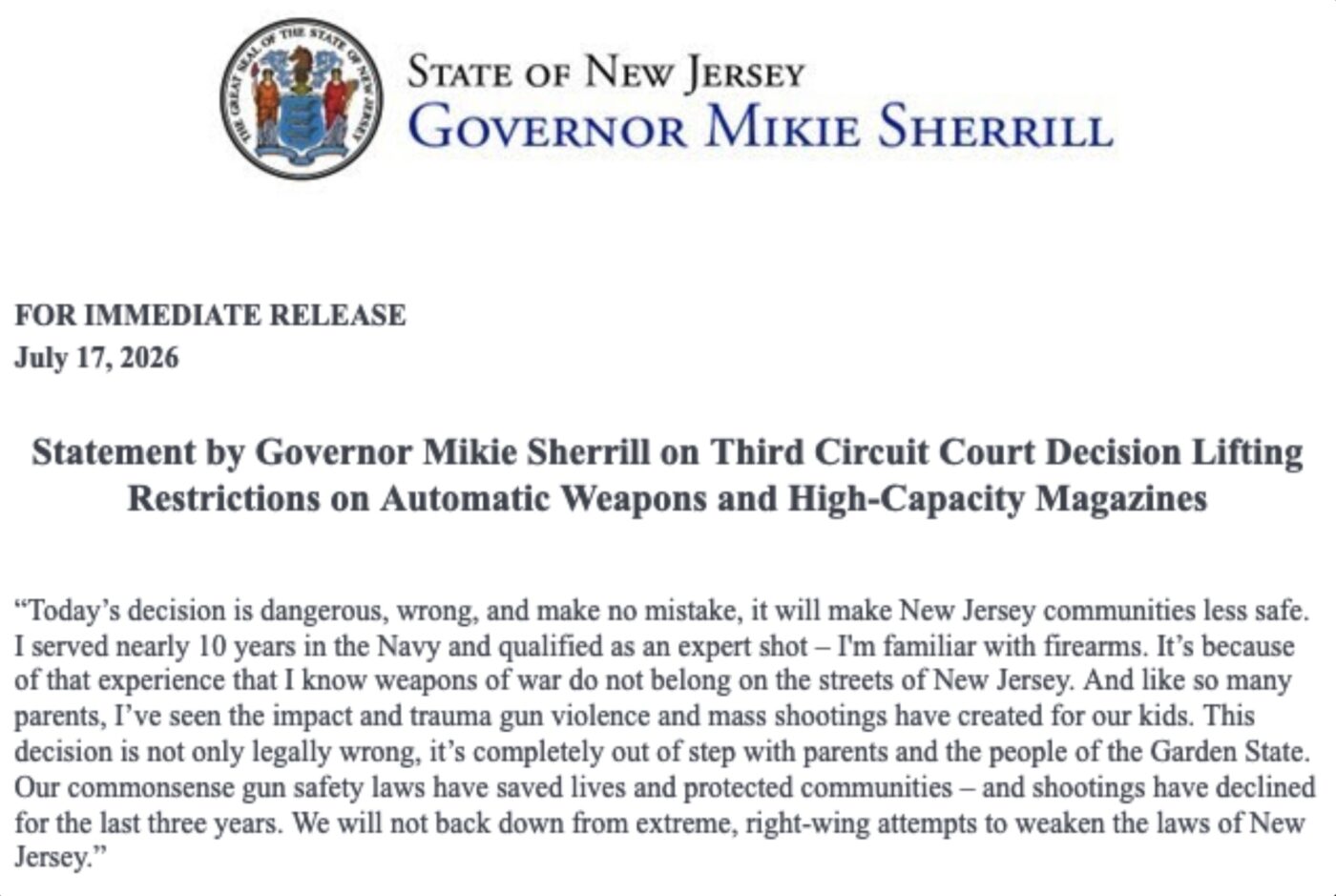
The New Jersey Governor responds: “We will not back down from extreme, right-wing attempts to weaken the laws of New Jersey.” So inaccurate for Governor Sherrill to claim these are “weapons of war.”
For examples of the Bowie knife regulations see:
Georgia (1837) — Restricted possession for purposes of carrying and imposed taxes and regulations on sale, but modern scholarship notes it was not a general prohibition on owning a Bowie knife in one’s home.
Alabama (1839) — Regulated concealed carry of Bowie knives rather than ownership.
Texas (1871) — Prohibited carrying Bowie knives “on or about the person,” but did not prohibit keeping one at home. Travelers and certain other exceptions existed.
Arkansas (1881) — Prohibited wearing or carrying Bowie knives but did not ban ownership.
also
Tennessee (1838) — was the most restrictive but even it did not prohibit owning one. Prohibited merchants from selling Bowie knives, prohibited concealed carry, and imposed enhanced penalties for assaults committed with Bowie knives. It did not generally prohibit simple possession in the home.




0 Comments