
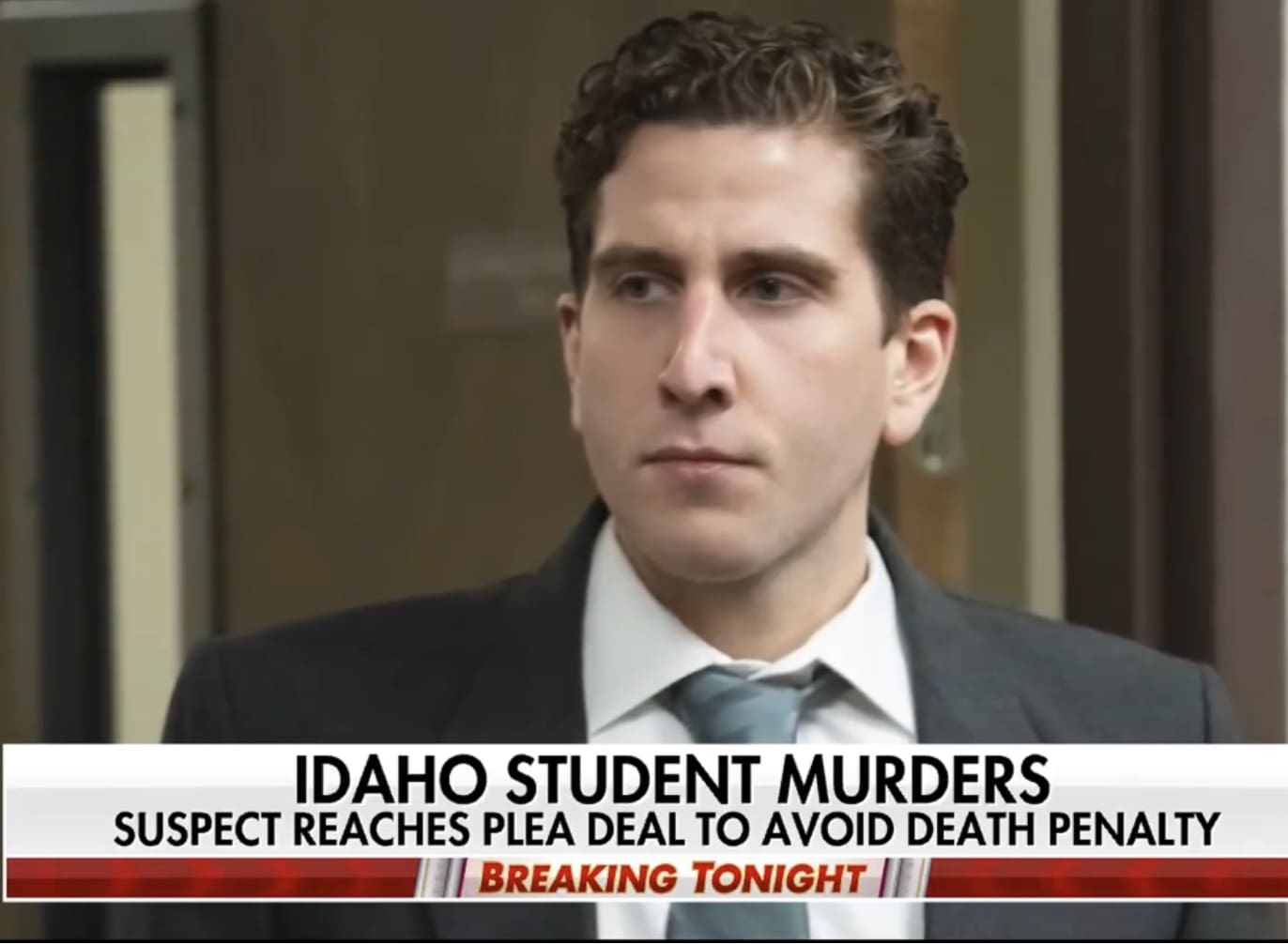
“While Life Imprisonment is tough, it’s certainly better than receiving the Death Penalty,” President Donald Trump wrote.
Michael Ruiz, :Trump weighs in on Bryan Kohberger’s plea deal ahead of crucial Idaho murders sentencing,” Fox News, July 21, 2025.
These cases illustrate instances where defendants facing the death penalty opted for plea agreements resulting in life imprisonment without parole just to avoid the death penalty. They would rather spend life in prison without parole than face the risk of the death penalty.
1. Bryan Kohberger (Idaho, 2022)
Bryan Kohberger, charged with the 2022 murders of four University of Idaho students, agreed to plead guilty in June 2025. In exchange, he will receive four consecutive life sentences without the possibility of parole, avoiding the death penalty. This decision came just weeks before his trial was set to begin.
2. James Holmes (Colorado, 2012)
On July 20, 2012, Holmes carried out a mass shooting at a movie theater in Aurora, Colorado, killing 12 people and injuring 70. In 2015, Holmes pleaded guilty to 24 counts of first-degree murder and 140 counts of attempted murder, among other charges, to avoid the death penalty. Prosecutors agreed to a plea deal that resulted in 12 consecutive life sentences without parole, plus an additional 3,318 years for attempted murder and explosives charges.
3. Nidal Hasan (Texas, 2009)
On November 5, 2009, Hasan, an Army psychiatrist, killed 13 people and injured over 30 in a shooting at Fort Hood, Texas. While Hasan did not formally accept a plea deal in the traditional sense, he attempted to plead guilty to avoid the death penalty in a military court-martial. Military rules prohibited guilty pleas in capital cases, so he was tried and sentenced to death in 2013. However, for the purposes of this list, it’s worth noting that Hasan’s case is an exception where a plea was offered but not accepted due to military law. Thus, he does not fully qualify, but I include it for clarity since plea negotiations were attempted.
4. Dylann Roof (South Carolina, 2015)
Dylann Roof, who murdered nine at the Emanuel African Methodist Episcopal Church in Charleston, South Carolina, agreed to plead guilty in order to avoid the death penalty. Without the threat of the death penalty, there would have been no reason to make a plea.
5. Eric Rudolph (Georgia, 1996)
Rudolph was responsible for multiple bombings, including the 1996 Atlanta Olympics bombing, which killed 1 person and injured 111, and other attacks on abortion clinics and a gay nightclub, resulting in additional deaths and injuries (total of 3 deaths across incidents). In 2005, Rudolph pleaded guilty to federal charges for the bombings in exchange for avoiding the death penalty. He received four consecutive life sentences without parole.
6. Patrick Crusius (El Paso, Texas, 2019)
Patrick Crusius, who killed 23 people in a racially motivated attack at a Walmart in El Paso, accepted a plea deal in March 2025. He was already sentenced to 90 consecutive life sentences for federal hate crimes in 2023. The state plea deal added a life sentence without parole, allowing him to avoid the death penalty.
7. Francisco Oropeza (San Jacinto County, Texas, 2023)
Francisco Oropeza pleaded guilty to the 2023 murders of five neighbors in San Jacinto County, Texas. By accepting a plea deal, he avoided the death penalty and was sentenced to life in prison without the possibility of parole.
8. Jared Lee Loughner (Tucson, Arizona, 2011)
Jared Lee Loughner, responsible for the 2011 Tucson shooting that killed six people and injured 13 others, including Congresswoman Gabrielle Giffords, pleaded guilty in 2012. He received multiple life sentences without parole, thereby avoiding the death penalty.
9. Gary Ridgway (Washington State, 1980s–1990s)
Known as the “Green River Killer,” Gary Ridgway confessed to 48 murders in 2003 as part of a plea bargain to avoid the death penalty. He was sentenced to 48 consecutive life terms without parole.
10. Raymont Hopewell (Baltimore, Maryland, 1999–2005)
Raymont Hopewell, who murdered five elderly individuals during home invasions, accepted a plea deal in 2006. He pleaded guilty to multiple charges, including murder and rape, and received life sentences without the possibility of parole, thus avoiding the death penalty.
11. Joseph James DeAngelo (California, 1974 to 1986)
Between 1974 and 1986, DeAngelo committed at least 13 murders, over 50 rapes, and numerous burglaries across California, known as the Golden State Killer. On June 29, 2020, DeAngelo pleaded guilty to 13 counts of first-degree murder and 13 counts of kidnapping as part of a plea bargain to avoid the death penalty. He also admitted to uncharged crimes, including rapes barred by the statute of limitations. On August 21, 2020, he was sentenced to multiple consecutive life sentences without parole.
Case that isn’t a traditional mass murder, but it was a high profile case.
1. Robert John Bardo (California, 1989)
In 1989, Bardo stalked and murdered actress Rebecca Schaeffer and was linked to other obsessive behaviors, though only one murder was charged. In 1991, Bardo pleaded guilty to first-degree murder to avoid the death penalty, receiving a life sentence without parole.



I don’t understand the question. Are you implying that the death penalty is a deterrence to crime or that murders don’t want to die? None of these cases proves the penalty of death deterred mass murder.
That the death penalty is more of a penalty than life in prison without parole.
So not really a deterrent to committing murder, just an inducement to avoid a trial. I think we should stop making plea deals where the evidence is so damning. Reserve it for when the evidence is shaky.